Gifted students don’t simply need more work. They need opportunities to do different kinds of work—work that asks them to investigate, make decisions, wrestle with ambiguity, test ideas, learn from failure, and improve what they create.
That is one reason project-based STEM and STEAM learning can be such a powerful fit for gifted education.
Imagine a fourth grader timing parachute drops using three different canopy sizes, graphing the results, and determining which variable to change next. Picture another student experimenting with a paddle boat to discover how paddle shape affects its performance.
These aren’t worksheets with a predetermined route to the correct answer. They are engineering problems that ask students to think.
The League of Young Inventors examples featured in the original Gifted Program Teacher newsletter illustrate this approach beautifully: students research, brainstorm, build, test, redesign, and communicate their thinking while working toward authentic design criteria.
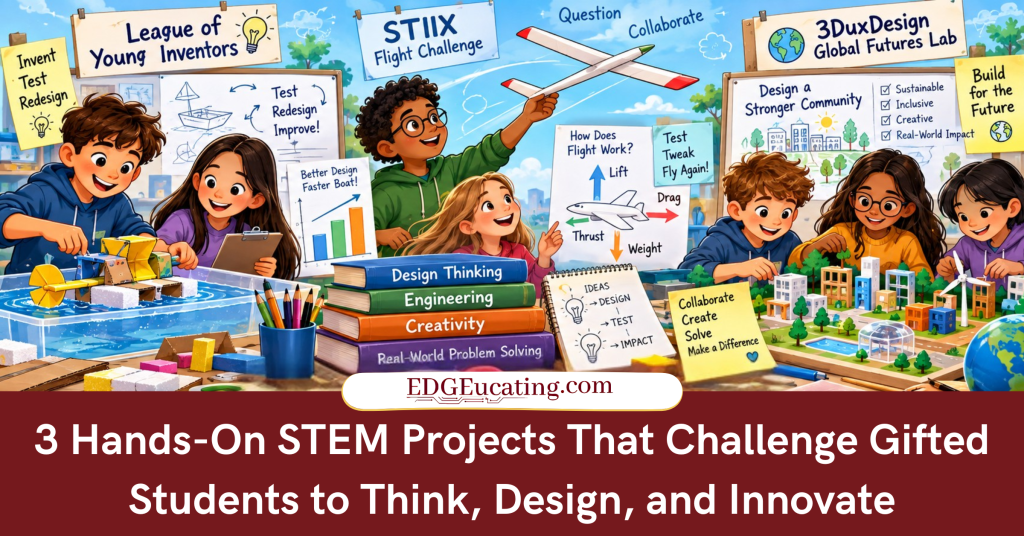
For educators looking to bring more rigor, creativity, choice, and real-world problem-solving into gifted programs, here are three project-based learning options worth exploring.
1. League of Young Inventors: Turn Students Into Engineers
The League of Young Inventors (LYI) places students inside the Engineering Design Process rather than simply teaching them about engineering.
Students investigate a problem, generate ideas, build prototypes, collect data, test their solutions, identify patterns, and improve their designs based on evidence. Current LYI curriculum options include projects involving parachutes, paddle boats, marble runs, bridges, neighborhood design, balancing mobiles, and more.
For gifted learners, the important distinction is that the challenge doesn’t have to end when a prototype “works.”
A student can ask:
- Can I make it work more efficiently?
- Which variable is having the greatest effect?
- What happens if I alter one constraint?
- Can I defend my design using evidence?
- Is there another solution that performs better?
- What tradeoffs did I make?
That shift—from completing an activity to optimizing a solution—creates room for deeper thinking.
A strong example: The Paddle Boat Challenge
In LYI’s Paddle Boats unit, students work through a propulsion challenge involving a rubber-band-powered paddle boat. They test materials and paddle configurations, using iterative engineering to achieve sustained motion. The experience emphasizes documenting successes as well as learning from designs that do not perform as expected.
That iterative process is especially valuable in gifted education because it makes productive struggle part of the learning experience.
The original Gifted Teachers resource also highlights the broader skills embedded in the process: planning, collaboration, persistence, redesign, presentation, executive functioning, and social-emotional learning.
Another advantage for gifted programs is flexibility. Many LYI projects have grade-banded versions, creating opportunities for advanced students to move into a more sophisticated challenge when they are ready.
For teachers, the barrier to implementation is also relatively low. LYI provides ready-to-teach instructional materials and hands-on supplies, allowing more of the classroom energy to go toward student thinking rather than teacher preparation. Current curriculum materials include slide-based lessons, teacher guidance, student materials, and building supplies.
Gifted education connection: Use the stated design challenge as the starting point, then invite students to establish an additional constraint, performance goal, or research question of their own.
2. STIIX: Connect Engineering Design With Career Exploration
A second option for gifted classrooms is STIIX, which combines hands-on engineering projects, curriculum, instructional videos, and career exploration.
STIIX describes its approach as a five-step Engineering Design Process in which students identify the problem, brainstorm, develop a plan, create, and then test and improve their work. The program is designed to reduce preparation demands on educators while keeping students actively engaged in design and construction.
Try this project: Design and Test a Glider
The STIIX Glider Project gives students an accessible entry point into aerospace engineering.
Students explore concepts including:
Force • Thrust • Lift • Drag
They then work individually or in small teams through the engineering design process to create, test, and improve their gliders. The project also connects the challenge to aerospace engineering as a career field.
For gifted students, the basic build can quickly become a deeper investigation.
Instead of asking only, “Whose glider travels farthest?” try asking:
Which design variable has the greatest influence on flight performance?
Students might investigate wing dimensions, mass distribution, launch angle, or another teacher-approved variable. They can conduct multiple trials, organize the data, calculate averages, graph performance, analyze anomalies, and defend a design recommendation.
Now a fun engineering activity has become a student-driven investigation involving science, mathematics, experimental design, data literacy, and communication.
STIIX also intentionally connects hands-on projects with careers. Its broader program includes STEM and career exploration resources as well as its STIIX-Ville augmented-reality career experience.
That makes the projects particularly interesting for gifted programs seeking to expand students’ understanding of where their strengths and interests might eventually lead.
Gifted education connection: Ask students to assume the role of an aerospace engineering consulting team. Their final product isn’t simply a glider—it is a design recommendation supported by test data.
3. 3DuxDesign Global Futures Design Lab: Design a Better Community
Engineering becomes even more meaningful when students use it to respond to the needs of other people.
That is a central idea behind the 3DuxDesign Global Futures Design Lab. (email for details: averweij@edgeucating.com )
Designed for students in grades 3 and above, Global Futures is an interdisciplinary, team-based design challenge in which students research, design, and build a model of a new community center shaped by a community’s needs, culture, and environment. Classes can investigate their own hometown or take a global pathway and explore another part of the world.
This adds something especially powerful to project-based learning: empathy.
Students aren’t just asking, “What can we build?”
They’re asking: Who are we designing for, and what do those people actually need?
The experience uses a four-step design-thinking process and 3D architectural modeling system. Students move from investigating a problem and stakeholders to developing possible solutions, evaluating ideas, collaboratively building a three-dimensional model, and presenting their thinking.
Why Global Futures works well for gifted learners
Global Futures is naturally interdisciplinary.
A single project can open doors into:
- architecture and engineering,
- geography,
- culture and global studies,
- sustainability,
- geometry and scale,
- economics,
- entrepreneurship,
- art and design,
- research and communication,
- civic engagement.
Students can also move into optional “Side Quest” extensions such as sustainable design, 3D drafting, art and architecture, entrepreneurship, designing for peace, tiny-house design, and multigenerational maker spaces.
This is an important feature for gifted classrooms because differentiation can occur through depth and complexity rather than simply acceleration.
One team might focus on renewable energy. Another could investigate accessibility. Another might examine local architectural traditions. A mathematically oriented student might analyze scale and cost while another researches community demographics or prepares a multimedia presentation.
Students can ultimately share projects through a Global Student Showcase, giving the work a potential audience beyond the classroom.
Gifted education connection: Require teams to justify every major design decision using research about their chosen community. This shifts the emphasis from “building something impressive” to designing something defensible and meaningful.
What These Three Projects Have in Common
League of Young Inventors, STIIX, and 3DuxDesign look different on the surface, but they share several characteristics that matter in gifted education.
Students are not merely following directions toward identical finished products. Instead, they encounter a challenge and make decisions.
They have opportunities to research, design, build, test, analyze, collaborate, communicate, and revise.
And perhaps most importantly, the first attempt does not have to be the final attempt.
That matters.
When gifted students encounter work they can finish quickly and correctly, they may have few opportunities to practice perseverance. Engineering and design challenges normalize the idea that an imperfect result isn’t the end of learning.
It’s information.
- A parachute that falls too quickly generates data.
- A glider that veers left raises a question.
- A community-center model that doesn’t meet the needs of its users requires reconsideration.
The thinking happens in the revision.
Moving From “STEM Activity” to Gifted Learning Experience
A great kit alone does not create rigor. The questions surrounding the project do.
When you introduce the next STEM experience to gifted students, consider adding prompts such as:
- What evidence supports your decision?
- Which constraint is limiting your design?
- What variable would you test next—and why?
- What tradeoff did your team make?
- Who benefits from your solution? Who might not?
- How would your solution change if the environment, user, budget, or materials changed?
- What did your unsuccessful prototype teach you?
Those questions transform making into thinking.
And that’s where project-based learning becomes especially powerful for gifted students.
Give Gifted Students Problems Worth Solving
Gifted classrooms should be places where students’ curiosity is not something to manage—it is something to activate.
Whether students are optimizing a paddle boat with the League of Young Inventors, investigating flight with a STIIX engineering project, or redesigning a community through 3DuxDesign’s Global Futures Design Lab, the goal is larger than building a successful prototype.
We are helping students become comfortable asking difficult questions, collaborating with others, learning from evidence, reconsidering their assumptions, and turning ideas into solutions.
Those are skills they can carry far beyond the gifted classroom.
Explore the programs:
League of Young Inventors offers K–8 engineering-design curriculum and hands-on materials.
STIIX provides hands-on STEM, engineering, and career exploration projects.
3DuxDesign‘s Global Futures Design Lab offers an interdisciplinary, community-centered design challenge for grades 3+.
If you are seeking professional development for topics related to Gifted Education, EDGEucating can help. Please reach out about PD, consulting, or any questions you might have. We are always ready and eager to assist!