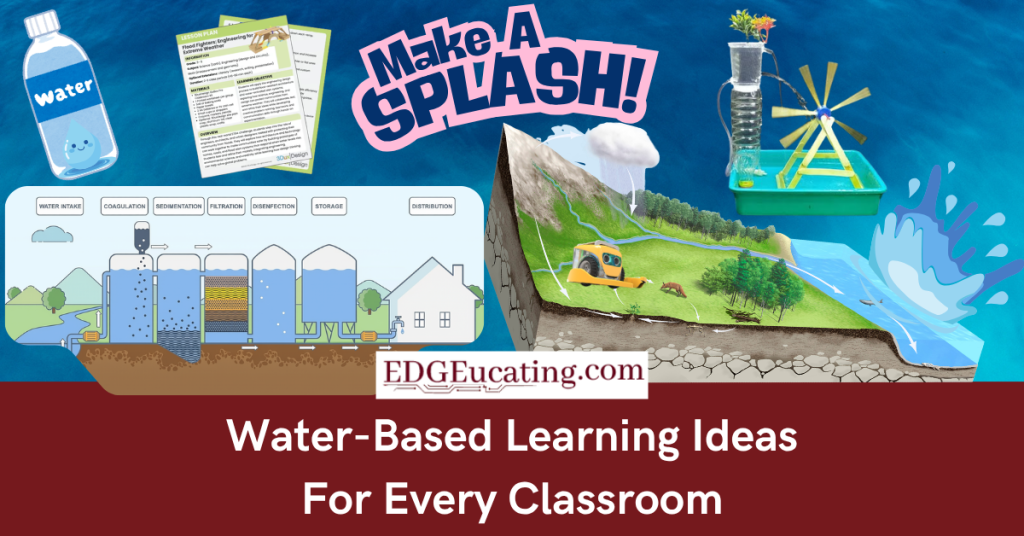
After more than 20 years in the classroom, I have found that students remember lessons best when they can investigate something familiar in an unfamiliar way. Water is perfect for this. Students encounter it every day, but it also opens the door to meaningful learning about weather, ecosystems, energy, engineering, transportation, community planning, and environmental responsibility.
Water activities do not have to be a single long unit or follow a prescribed sequence. A teacher might use a single lesson to reinforce a science standard, create a weeklong design challenge, or place several water investigations at maker stations. Some activities bring outdoor phenomena into the classroom through models and simulations. Others take students outside to observe rainfall, runoff, sunlight, wind, and drainage firsthand.
The following lesson ideas can stand alone or be adapted across grade levels.
Explore the Water Cycle Through Coding and Immersive Technology
Recommended grades: 6-12
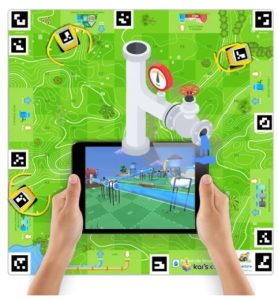 The Kai’s Clan Water Cycle AR/VR Activity Mat gives students a physical and digital environment for exploring how water moves through interconnected systems. The mat provides access to water-cycle lessons and a three-dimensional co
ding environment that can be viewed and manipulated through a web browser, augmented reality, or virtual reality.
One lesson idea is to ask students to code a water droplet’s journey through evaporation, condensation, precipitation, collection, and runoff. Younger learners can sequence the stages and explain them orally. Older students can introduce obstacles, changing weather conditions, or human-built systems, like farms, that alter the droplet’s path.
The mat can also inspire a “schoolyard watershed” investigation. Students first predict where rain travels around the campus. They then go outside to examine slopes, gutters, storm drains, vegetation, pavement, and puddling. Back inside, they revise their digital or physical models based on their observations.
This activity supports Earth science, sequencing, systems thinking, coding, spatial reasoning, and scientific communication.
Create a Mobile Water Lab With the edm8ker Makercart
Recommended grades: 3–8, with extensions for grades 9–10
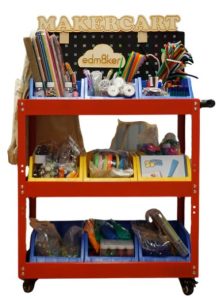 The edm8ker Mobile Makercart makes it easy to offer hands-on STEM activities without creating a permanent makerspace. Teachers select four activities from a larger catalog, and the cart includes organized materials and instructional resources such as lesson plans, slide decks, and worksheets. Each selected activity includes materials for repeated student projects.
Four water-focused choices are:
H2-Oh Yeah! (DIY Water Wheel) — recommended for grades 3–8
Clean Water Heroes Challenge! (DIY Water Filter) — recommended for grades 3–8
Catch the Rain! — recommended for grades 2–7
Sun-tastic Still! (Solar Still) — recommended for grades 6–10
These activities can be offered as independent stations rather than as a multi-step unit.
With Clean Water Heroes Challenge!, students compare layers of gravel, sand, fabric, cotton, or other approved materials. Elementary students can focus on observation and comparison, while middle school students measure filtration time, water volume, and clarity. Students should always be reminded that clearer experimental water is not necessarily safe to drink.
In H2-Oh Yeah!, students investigate how moving water can transfer energy. They can change the number, size, angle, or material of the blades and record how each modification affects movement. Older students can calculate rotations per minute or compare efficiency under different flow rates.
Catch the Rain! provides a natural reason to go outside. Students can place collection systems in several locations, measure rainfall, graph results, and compare precipitation with puddling or runoff. Older learners can discuss variables such as placement, wind, nearby buildings, and measurement reliability.
With Sun-tastic Still!, students explore evaporation and condensation by building a solar still. They can investigate how sunlight, temperature, container shape, and placement affect water collection. Older students can measure output over time, compare designs, and discuss how solar distillation may be used in places with limited access to clean water.
Design a Fair Community Water Network
Recommended grades: 4–8
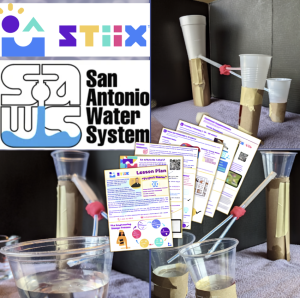 The STIIX Water System Project challenges students to create a functional system that carries water from a central tower to multiple homes. Set in the fictional community of STIIX-Ville, the project introduces gravity-fed flow, pressure, fluid dynamics, systems design, and civil engineering. It also asks students to consider equitable water distribution as the community grows.
A classroom lesson might begin with one simple question: Can every home receive enough water?
Teams can design different neighborhood layouts and test how height, distance, pipe length, and branching pathways affect water delivery. Younger students can compare which homes receive water first. Older students can measure volume, calculate differences, identify pressure problems, and revise the network.
The activity also supports social studies and civic learning. Students can discuss why water infrastructure matters, who makes decisions about public systems, and what fairness looks like when resources are limited.
For an outdoor connection, students can look for water towers, pipes, utility markers, irrigation lines, storm drains, and downspouts around the school. Even when the infrastructure is partly hidden, students begin to recognize that water reaches buildings through carefully planned systems.
Compare Water-Filter Designs
Recommended grades: 3–8
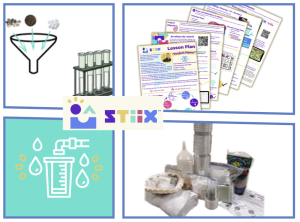 The STIIX Water Filter Project asks students to apply environmental science and engineering design as they create and compare filters made from everyday materials. Students investigate water clarity, document their process, test different designs, and analyze effectiveness.
This project works well as a one-day comparison lesson or a longer design challenge. Teams can receive identical materials but choose their own arrangement.
They might measure:
- Filtration time
- Amount of water collected
- Visible sediment remaining
- Material cost
- Number or thickness of filter layers
Grades 3–5 can describe changes and rank designs using a class-created rubric. Grades 6–8 can identify variables, average results from repeated trials, create graphs, and explain whether the evidence supports their conclusions.
A useful literacy extension is to have students write a recommendation for a fictional community. They must support their choice with test data rather than simply selecting the filter that looks best.
Build Flood-Resistant Communities and Water Sensors
Recommended grades: 3–6
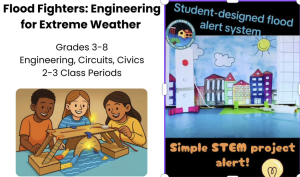 The 3DuxDesign Flood Fighters: Engineering for Extreme Weather lesson brings together Earth science, architecture, circuitry, measurement, geometry, and community planning. Using materials from a 3DuxDesign GOBOX Pro Classroom Kit, students design flood-resistant structures and create water-activated alert systems that respond when rising water reaches a sensor.
The challenge becomes even more relevant when students connect their models to hurricanes and recent floods. Hurricane Helene, for example, caused destructive storm surge near the coast and catastrophic flooding far inland across parts of the southeastern United States. More recent flash flooding in Central Texas demonstrated how quickly heavy rainfall can overwhelm rivers, roads, buildings, and evacuation routes. These events show students that flood preparation is not only a coastal concern and that communities must plan for several hazards at once.
Teachers can present students with a fictional hurricane forecast or recent flooding scenario and assign each team a different obstacle to solve. One team might protect homes from rising water, while another designs a safe evacuation route, reinforces a bridge, redirects runoff, protects a hospital, or places shelters on higher ground. Other teams could address blocked storm drains, washed-out roads, power loss, damaged water systems, or neighborhoods isolated by flooding.
Students can build and compare homes on stilts, raised foundations, floating platforms, or protected landforms. They can also add levees, retention areas, drainage channels, permeable surfaces, raised walkways, and barriers, then introduce controlled amounts of water to see which solutions reduce damage. After each test, students measure water depth, record where flooding occurred, identify points of failure, and revise their designs.
The circuitry component adds an early-warning challenge. Students use a treated paper-towel strip as part of an open circuit. When water reaches the strip, it becomes conductive enough to close the circuit and activate an LED. The lesson’s circuit diagram shows the basic setup, while the building instructions explain how to mount the sensor and provide a clear path for rising water to reach it.
Students must then decide where the warning sensor will provide the greatest protection. Should it be placed beside a river, beneath a bridge, near a low-lying road, outside a home, or along an evacuation route? They can test several locations and consider whether the alert provides enough time for residents to respond.
For an additional constraint, announce that the hurricane has changed direction, rainfall has increased, or one community resource is no longer available. Students must adapt their models without starting over. This mirrors the work of real engineers and emergency planners, who must respond to changing conditions while balancing safety, cost, access, and limited materials.
The result is more than a model town. It is an opportunity for students to use scientific evidence, mathematical reasoning, engineering design, and empathy to explore how communities can prepare for hurricanes and reduce the effects of future flooding.
Power a Water-Resilient Community With Renewable Energy
Recommended grades: 4–12
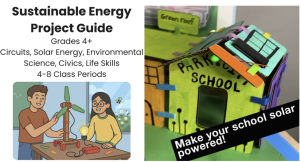 The 3DuxDesign Sustainable Energy Add-On Set includes solar panels, wind turbines, LEDs, miniature voltmeters, and circuit materials. Students can measure electricity generated by solar and wind sources and use that energy to power a model community. The set is designed as a supplement to 3DuxDesign GOBOX classroom products.
One lesson idea is to power a flood-warning light with renewable energy. Students can test solar panels at different angles or under different light conditions. They can also test wind turbines in various locations or at different fan speeds.
Grades 4–6 can compare which conditions produce brighter lights or higher meter readings. Grades 7–12 can collect voltage data, graph results, discuss reliability, and design a backup-energy plan for an emergency shelter or water-treatment station.
Taking the equipment outside makes the investigation more authentic. Students can measure sunlight and wind in different parts of the school grounds, then recommend locations for renewable-energy installations.
Let Water Connect the Curriculum
Water-based learning is powerful because it does not belong to only one subject. A filtration challenge includes science, measurement, data analysis, and persuasive writing. A flood-resistant town combines Earth science, geometry, circuitry, architecture, and civics. A rain gauge turns the schoolyard into a laboratory. A coded water cycle makes an invisible global process easier to see.
The product is not the lesson by itself. The lesson comes alive through the questions students ask, the evidence they collect, the designs they revise, and the connections they make to their own communities.
Sometimes bringing the outside inside means building a watershed on a table. Sometimes it means using AR or VR to travel with a water droplet. Sometimes the best choice is simply to take students outdoors after a storm and ask, “Where did the water go?”
That one question can lead almost anywhere. Where will it lead you and your students?