Every teacher knows the frustration of finding out that a student finished an assignment but somehow never submitted it. As a classroom teacher, I can confidently say that getting students to hand in their work was often a struggle—even when they had already completed it.
The assignment might be finished. The answers might be correct. The student might even remember doing the work. But when it was time to submit it, the paper had disappeared into a backpack, desk, binder, locker, or an unknown corner of the classroom.
For almost half of my teaching career, I worked with gifted students. Many people assume gifted learners are naturally organized, independent, and able to manage their assignments without much support. In my experience, that was often far from the truth.
Some of my most capable students were also the most likely to complete an assignment and then be unable to locate it when it was time to turn it in. They could solve complex problems, generate highly creative ideas, and engage deeply with challenging content, yet still lose the paper they had finished ten minutes earlier.
This can also be common among students with ADD or ADHD, who may struggle with organization, working memory, planning, task initiation, and follow-through. A student may understand the academic content perfectly but still have difficulty managing all the steps required to complete and submit the assignment.
That distinction matters.
Missing work is not always a sign that a student is lazy, unmotivated, or unwilling to participate. Sometimes the problem is not completing the assignment. Sometimes the problem is keeping track of it, remembering where it belongs, and following through on the final submission step.
The goal is not to eliminate accountability. The goal is to create classroom systems that help students become more successful, organized, and independent over time.
Here are six practical, cutting-EDGE strategies that can help students finish, locate, and submit their work more consistently.
1. Create a Clear Path to Completion
A due date tells students when an assignment should be finished. It does not always tell them how to get there.
Before posting or distributing an assignment, look at it from the student’s perspective:
- What should I do first?
- What materials do I need?
- What does a successful response look like?
- Where should I keep the assignment while I am working?
- How will I know when I am finished?
- Where do I turn it in?
These questions may seem obvious to adults, but many students need the process made visible. This is no different than you needing this information for a lesson that you have never taught before.
Instead of giving one large block of directions, break the assignment into a short sequence of numbered steps. Add a checklist, model, example, visual, or brief teacher demonstration when appropriate. Remember to give guidance but not too much, especially in the example area. You want the students to come up with ideas without bias from an existing option, so use caution and limit information when it comes to examples.
Evidence-based instructional practices support teaching in small steps, modeling processes, guiding practice, checking for understanding, and providing temporary scaffolds during challenging work.
Classroom Example: Elementary Science
Instead of saying, “Create a presentation about an animal habitat,” provide a clear path:
- Select an animal.
- Identify its habitat.
- Record three facts.
- Add a drawing or image.
- Explain one adaptation.
- Review the checklist.
- Submit the final slide.
The academic expectations remain high, but the pathway is easier to follow.
Classroom Example: Middle School Engineering
For a bridge-building challenge, provide one project guide that includes:
- The design requirements
- A materials list
- A sketching template
- The testing procedure
- The reflection questions
- The submission location
This prevents students from having to search through several documents, online posts, and classroom locations before they can begin.
EDGEucator Tip:
Record a brief screen-capture video showing students where to find the assignment, how to complete it, and how to submit it. A short demonstration can remove unnecessary barriers and give students a resource they can review independently, particularly when students are completing the activity remotely (such as homebound students).
2. Use Physical Folders That Never Leave the Classroom
One of the simplest and most effective systems I used was a physical folder for each student.
The rule was straightforward:
The folders did not leave the classroom. Ever!
The folders were handed out at the beginning of each class period and collected before students left. Any work that was still in progress stayed inside the folder. Completed work went directly into a designated hand-in bin.
This system was especially helpful for students who regularly lost papers, forgot assignments at home, or completed work but could not find it when it was time to submit it.
It also reduced the number of variables students had to manage.
They did not need to remember:
- Which binder contained the assignment
- Whether they had placed it in their backpack
- Whether they had taken it home
- Whether it was still in a locker
- Whether it had been left in another classroom
The unfinished work stayed in one predictable location.
How the Folder System Worked
At the beginning of class:
- Students received their individual folders.
- They removed the current assignment or project materials.
- They continued working from where they had stopped.
Before leaving class:
- Students reviewed their work.
- Work in progress went back into the folder.
- Completed work went into the hand-in bin.
- The folders were collected and stored in the classroom.
This routine created a clear distinction between two categories:
Still working: Place it in the folder.
Finished: Place it in the hand-in bin.
That simple structure kept materials organized, minimized lost work, and supported students who struggled with executive-function skills.
Why This Helps Gifted and ADHD Learners
Gifted students may become deeply absorbed in ideas while overlooking routine organizational steps. They may rush through a task, move quickly to the next challenge, or assume they will remember where they placed something.
Students with ADHD may experience difficulty with working memory, organization, attention shifting, and task completion. The physical folder acts as an external support. Instead of relying entirely on memory, the classroom system provides a consistent place for unfinished work.
The folder does not lower expectations. It removes an unnecessary barrier between completing the learning and receiving credit for it.
EDGEucator Tip:
Color-code folders by class period, subject, or project. Avoid creating an overly complicated system. One folder, one location, and one routine are often more effective than multiple organizers that students must remember to manage.
3. Turn One Large Deadline Into Smaller Checkpoints
Large assignments require more than subject knowledge. They also require students to plan, organize, prioritize, monitor their progress, and manage time.
These skills are still developing, even among academically advanced students.
A gifted student may be capable of producing exceptional work but delay beginning because the task feels repetitive, uninteresting, or overwhelming. Another student may spend so much time perfecting one part of the assignment that the rest is never completed.
Rather than relying on one final deadline, divide larger projects into meaningful checkpoints.
A research project might include:
- Topic selection
- Research question
- Source list
- Outline
- First section
- Complete draft
- Peer-feedback response
- Final submission
These checkpoints should reflect genuine progress rather than create additional busywork.
Classroom Example: STEAM Design Challenge
Imagine that students are designing an accessible playground for their community.
Instead of setting one deadline three weeks away, establish a series of checkpoints:
Checkpoint 1: Identify the needs of playground users.
Checkpoint 2: Research accessibility and safety considerations.
Checkpoint 3: Create a labeled design sketch.
Checkpoint 4: Build a prototype.
Checkpoint 5: Test the design and document changes.
Checkpoint 6: Present the final solution.
Each checkpoint can be brief. Students might submit a sketch, photograph, audio reflection, planning sheet, or short progress update.
Classroom Example: English Language Arts
For a multimedia book review, students could first submit:
- A central claim
- Three supporting details
- A storyboard
- A rough recording
- A revised final product
By the time the final project is due, most of the thinking and planning have already been completed.
Use the Folder System With Checkpoints
Physical folders work especially well with long-term projects.
Each student’s folder can contain:
- The project instructions
- A milestone checklist
- Research notes
- Drafts
- Teacher feedback
- Unfinished components
Completed checkpoints can be submitted, stamped, initialed, or recorded while the remaining materials stay safely in the classroom folder.
4. Build Submission Into the Classroom Routine
Students should not have to rely entirely on memory to submit their work.
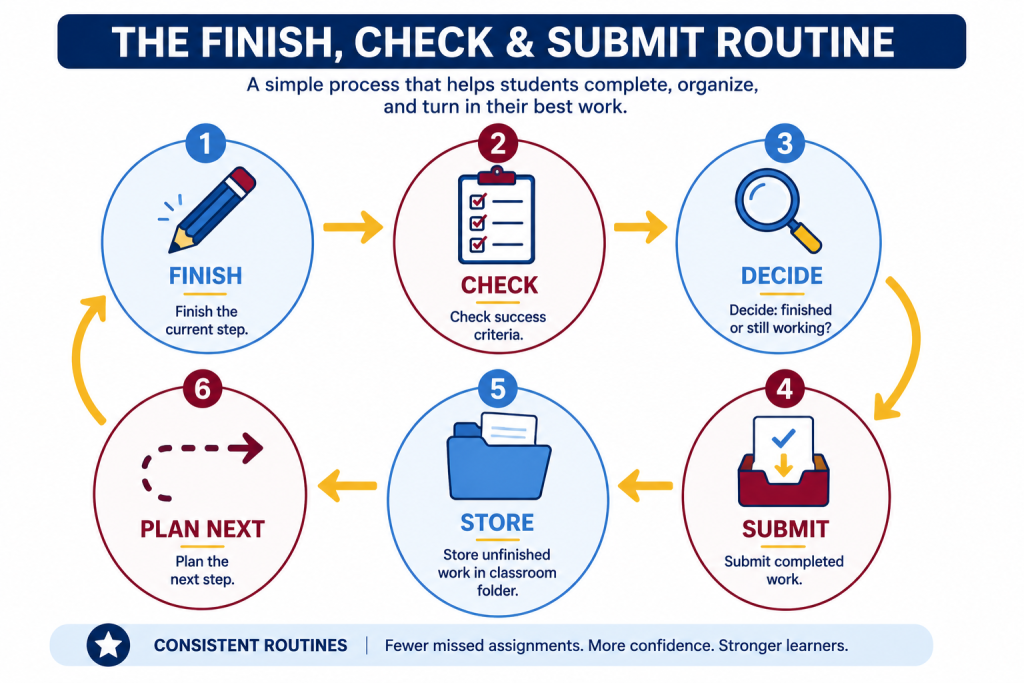
Create a predictable routine at the end of every class period. Reserve the final few minutes for a “Finish, Check, and Submit” process.
Students can:
- Finish the current step.
- Compare their work with the success criteria.
- Decide whether the work is complete or still in progress.
- Place completed work in the hand-in bin.
- Return unfinished work to the classroom folder.
- Record their next step.
The key is consistency.
When students repeat the same process every day, submission becomes part of the learning routine rather than an optional final step.
Classroom Example: Robotics
Students working with Bee-Bot, Ozobot, KIBO, or another robotics platform may not finish a challenge during one class period.
Their evidence of progress might include:
- A photograph of the current build
- A screenshot of the code
- A short video of a test
- A sentence explaining a problem
- A prediction about the next revision
The planning sheet, coding notes, and unfinished reflection can remain in the classroom folder until the next lesson.
Classroom Example: Mathematics
At the end of a collaborative problem-solving lesson, each student might submit:
- A photograph of the group model with an individual explanation
- A worked example
- A voice recording explaining the strategy
- A digital exit ticket
- A question they still have
Submission does not always need to involve a full worksheet. It needs to provide meaningful evidence of student thinking.
5. Teach Students to Plan Backward
Posting a deadline once is rarely enough.
Students are managing due dates across multiple classes, digital platforms, extracurricular activities, sports schedules, jobs, and family responsibilities. Some students need direct instruction in turning a deadline into a workable plan.
Teach students to work backward:
- When is the final assignment due?
- What must be completed immediately before that?
- How long will each step take?
- When will I work on each part?
- What materials will I need?
- Where will I keep the work?
- What will I do if I fall behind?
The question about where the work will be kept is important. A plan is not complete if students know when they will work but lose the materials between class periods.
Classroom Example: High School History
Suppose a documentary project is due on Friday.
Students might plan backward:
Friday: Submit and present.
Thursday: Export and review the video.
Wednesday: Finish editing.
Tuesday: Record narration.
Monday: Organize images, citations, and the script.
All paper notes, scripts, and planning materials can remain inside the classroom folder until the project is complete.
Classroom Example: Upper Elementary
Use a paper project road map with spaces for:
- Today’s task
- My next task
- Help I need
- Materials I need
- Where my work belongs
- My next checkpoint
Young learners can use icons, drawings, or colors instead of lengthy written plans.
Make Reminders Actionable
Instead of writing:
Your project is due Friday.
Try:
Your prototype is due Friday. Today, complete the testing section and place your planning sheet back in your classroom folder.
The second reminder gives students a specific action and reinforces the organizational routine.
6. Make Feedback Part of the Work Cycle
Students are more likely to value submission when they know their work will be seen, discussed, and used.
When feedback arrives weeks later—or consists only of a grade—students may view submission as the end of the learning process.
Instead, create short feedback loops while the work is still developing.
Effective feedback helps students answer three questions:
- Where am I going?
- How am I doing?
- What should I do next?
Classroom Example: Writing Conference
A teacher might say:
Your claim is clear, and your first piece of evidence is strong. Your next step is to explain how the second quote supports your claim. Add that explanation before tomorrow’s checkpoint.
The student now has a specific next step. The draft can then return to the classroom folder until the next work period.
Classroom Example: Coding Project
During a Scratch animation project, ask the student to run the program and explain the code.
Then provide one focused challenge:
Your sequence works. Now add a conditional statement so the character responds when the user clicks the object.
The student receives immediate feedback and a clear reason to continue working.
Classroom Example: Peer Feedback
Give students a simple structure:
- One element that is working
- One question
- One suggested next step
Keep peer-feedback forms inside the project folder so students can refer to them during revision.
EDGEucator Tip:
Do not provide feedback on everything at once. Select one or two high-impact criteria. Students are more likely to use focused feedback than a page covered with corrections.
Respond to Missing Work With Curiosity and Accountability
When a student does not submit an assignment, begin with a question rather than an assumption.
Try:
I noticed your assignment was not submitted. Show me where you got stuck.
The answer may reveal that the student:
- Did not understand the first step
- Could not access a tool or file
- Thought a partner had submitted the work
- Completed the assignment but forgot to turn it in
- Placed the paper in the wrong location
- Became overwhelmed by the size of the task
- Needed additional organizational support
- Was dealing with circumstances outside the classroom
In my experience, the answer was often surprisingly simple: the student had completed the work but could not find it.
That is why organizational systems matter.
When unfinished work remains in a classroom folder and completed work goes directly into a hand-in bin, the number of possible locations is dramatically reduced.
Understanding the barrier does not mean removing the expectation. It allows the teacher and student to create a realistic plan for completion.
Use a Brief Reset Conference
A reset conference can include four questions:
- What have you completed?
- Where is the work now?
- What stopped you from submitting it?
- What is the next step?
Then create a specific plan:
You completed the research, and the notes are in your classroom folder. Today, begin the first two slides. Tomorrow, finish the remaining slides and place the completed rubric in the hand-in bin.
This approach combines support with accountability.
Protect Student Dignity
Avoid publicly displaying the names of students with missing work.
A whole-class progress chart can be motivating, but it should not embarrass, label, or isolate students. Private check-ins, strengths-based language, and respectful problem-solving preserve belonging while reinforcing responsibility.
This is particularly important for students who already know they struggle with organization.
Many have heard comments such as:
- “You need to be more responsible.”
- “How did you lose it again?”
- “You are capable of doing better.”
- “You would succeed if you were more organized.”
These statements may express frustration, but they do not teach the missing skill.
A reliable classroom routine does.
The EDGE Assignment-Completion Framework
Before launching your next assignment, use the EDGE Completion Check.
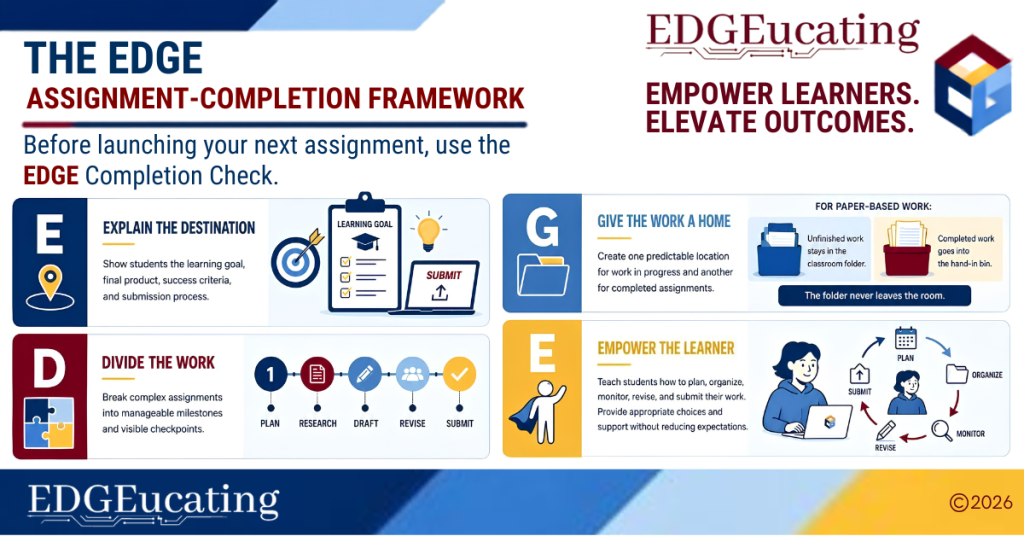
E — Explain the Destination
Show students the learning goal, final product, success criteria, and submission process.
D — Divide the Work
Break complex assignments into manageable milestones and visible checkpoints.
G — Give the Work a Home
Create one predictable location for work in progress and another for completed assignments.
For paper-based work:
- Unfinished work stays in the classroom folder.
- Completed work goes into the hand-in bin.
- The folder never leaves the room.
E — Empower the Learner
Teach students how to plan, organize, monitor, revise, and submit their work. Provide appropriate choices and support without reducing expectations.
Final Thoughts: Better Systems Build More Independent Learners
Students do not become responsible simply because we repeatedly tell them to be responsible.
They develop responsibility by practicing the skills that responsibility requires.
After decades of teaching, I learned that many students did not need another reminder to “turn in your work.” They needed a dependable system that made it easier to keep track of the work from beginning to end.
This was true for students who struggled academically. It was true for students with ADD or ADHD. It was also true for many of the gifted students I taught during almost half of my career.
Intelligence does not automatically create organization.
Completing an assignment does not automatically lead to submitting it.
A student may need explicit support with:
- Starting the task
- Breaking it into steps
- Managing materials
- Monitoring progress
- Locating the finished product
- Completing the final hand-in step
Start small.
For your next assignment, consider adding:
- A clear completion path
- Two or three checkpoints
- A classroom folder that never leaves the room
- A designated hand-in bin
- A consistent end-of-class routine
- One focused feedback opportunity
- A brief plan for students who get stuck
These strategies do not require an expensive program or complicated technology. Sometimes one folder, one bin, and one consistent routine can make a meaningful difference.
At EDGEucating, we believe practical innovation should make learning more inclusive, engaging, and attainable for every student. When classroom systems are designed with clarity, consistency, flexibility, and purpose, students are not simply turning in more assignments.
They are learning how to manage meaningful work.
That is a skill worth teaching!